Is Magic Win Casino Legit? Trust, Reputation and UK Context
 Available in GB
Magic Win is an operating casino brand that accepts UK players in the available evidence, but no UK Gambling Commission licence for Magic Win was verified in the current public-register check. That distinction is central to any answer about whether Magic Win is “legit”. Operational access tells you that the service can be used; it does not establish UKGC authorisation or the consumer protections that come with a Great Britain licence.
There is also a strong negative reputation signal. Current Trustpilot feedback is heavily weighted towards one-star reviews, with recurring user complaints about withdrawals and support. Those reports matter when judging risk, but they are not regulatory findings and do not prove that every customer will have the same experience. The most useful assessment is therefore evidence-based rather than binary: Magic Win is a functioning brand, while its unverified UKGC status and poor recent review sentiment are material concerns for a player in Great Britain.
Table of Contents
- Magic Win trust factors at a glance
- What does “legit” actually mean for a UK casino?
- No verified UKGC licence: why that matters
- Reputation: what current Magic Win reviews show
- Why poor reviews are a risk signal, not a regulator finding
- Support availability versus support quality
- Availability is not the same as authorisation
- Great Britain and Northern Ireland are not identical here
- Five checks before deciding whether to use Magic Win
- What the available information does not claim
- How the evidence shapes the trust picture
- Is Magic Win Casino Legit? Trust, Reputation and UK Context
Magic Win trust factors at a glance
| Trust factor | Current evidence | How to interpret it |
|---|---|---|
| Brand operation | Magic Win launched in 2022 and accepts UK players in the available evidence. | Shows operational availability, not regulatory approval. |
| UKGC licence | No Magic Win licence was verified in the current UKGC public register check. | Do not assume UKGC licence protections or UKGC-approved complaint routes apply. |
| Offshore licence context | Publicly available information identifies a Curaçao licensing jurisdiction, but no exact credential number is stated. | An offshore licence is a separate fact from UKGC authorisation. |
| Current player sentiment | Recent Trustpilot feedback is strongly negative and frequently discusses withdrawals and support. | A meaningful reputation signal, but still subjective user reporting. |
| Support access | Live chat is reported as available and a published support email is listed. | Useful for contacting the operator, but channel availability does not measure resolution quality. |
This table deliberately avoids a green or red “safe” badge. A single label would collapse very different questions into one answer. A casino can be operational, have a licence in one jurisdiction, lack a verified licence in another jurisdiction and receive poor public reviews at the same time. Those facts should be weighed separately.
What does “legit” actually mean for a UK casino?
When readers ask whether an online casino is legit, they often mean several things at once: does the site exist, can it take deposits, does it offer real games, is it licensed for the reader’s location, are withdrawals handled predictably, and is there a recognised route if a dispute develops? No single data point answers all of those questions.
For Magic Win, operational facts are the easiest part. The brand is established in the current evidence, launched in 2022 and is described as accepting UK players. Its game library, payment options and mobile browser access are covered elsewhere in this information using independently verified facts. Those product facts are not weakened merely because a local UKGC licence was not found. Licence status is an isolated regulatory fact, not a reason to rewrite unrelated features as uncertain.
The harder part is regulatory protection. The UK Gambling Commission regulates commercial gambling in Great Britain, meaning England, Scotland and Wales. Its current guidance says businesses providing remote gambling facilities to consumers in Great Britain need a Commission licence. The detailed Magic Win licence page explains the register result and its limits.
No verified UKGC licence: why that matters
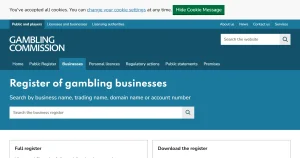
The current register check did not verify Magic Win in the UKGC public business register. The register is the correct primary source for a claim that an operator is licensed by the Commission. Because there is no verified hit, this information does not say or imply that Magic Win is UKGC licensed, covered by UKGC consumer safeguards, part of a UKGC-approved alternative dispute resolution arrangement, or within UKGC-mandated schemes simply by virtue of serving UK players.
That matters most for players in Great Britain because the Commission’s licensing framework is the local regulatory system for remote operators serving consumers there. A reader should not treat an offshore licence as a substitute for a UKGC operating licence. They are different authorisations, issued by different authorities under different rules.
At the same time, the register result should not be stretched beyond what it proves. A no-hit outcome does not by itself prove that the site cannot technically be accessed, that every transaction will fail, or that a particular player has suffered misconduct. It also does not justify a blanket statement about legality throughout the whole United Kingdom. Northern Ireland has a distinct gambling regime, which is why this information uses “Great Britain” when discussing the ordinary UKGC licensing scope.
Reputation: what current Magic Win reviews show
The strongest current reputation signal is the Magic Win Trustpilot profile. On 12 September 2026, the profile displayed a 1.3 score from 293 reviews, with 93% of ratings at one star. Recent reviews frequently describe delayed withdrawals, repeated support replies and frustration about unresolved account issues. That volume and consistency make the pattern relevant to a prospective player’s decision.
However, the correct statement is that users have reported those experiences. It would be incorrect to turn review allegations into findings of fact. Trustpilot itself presents reviews as individual opinions, not regulatory determinations or audited transaction records. Some complaints may be accurate, incomplete, disputed or affected by account-specific circumstances that are invisible to an outside reader.
The current profile also contains at least one recent reviewer who said a withdrawal was eventually received after the reviewer had become worried by other comments. That does not cancel the broader negative pattern, but it prevents an absolute claim such as “Magic Win never pays”. For withdrawal-specific evidence, including how to document a delayed request without overclaiming, use the withdrawal review.
Why poor reviews are a risk signal, not a regulator finding
Public reviews are most useful when you treat them as patterns rather than assessments. A pattern of recent complaints about the same part of a service can identify where users report friction. It can tell you what to scrutinise before depositing and what records to keep if you decide to proceed. It cannot tell you with certainty what happened inside every account.
That difference is especially important with allegations such as “scam”, “stolen funds” or “fake casino”. Reviewers may use those words to express frustration, but those labels should not be treated as established facts. A regulatory finding would require evidence and a competent authority or adjudicative process. Review sentiment is a reputation input, not a substitute for that process.
For a practical decision, the question is simpler: are the complaint themes frequent and recent enough that they change your tolerance for risk? On the current evidence, the answer is yes for readers who prioritise fast, predictable withdrawals or responsive human support. That is a decision-useful finding without making an accusation that the evidence does not establish.
Support availability versus support quality
Live chat is reported as available, and [email protected] is listed as a published contact address on the public profile. These are useful channels because they provide ways to ask account-specific questions and create a written record of an issue.
Channel availability is not the same as support quality. Current public reviews include repeated complaints about automated or repetitive replies, but those are user reports. It cannot be inferred from a review that every chat is automated, that no staff member can intervene, or that a particular case will be ignored.
If you use support, ask specific questions that create a useful record: what is the current status, is any action required from you, what account or transaction reference applies, and when was the issue last updated? Save the reply. The quality of a support interaction is easier to judge from a clear timeline than from the mere existence of a chat widget or email address.
Availability is not the same as authorisation
One of the easiest mistakes in offshore casino reviews is to treat access as proof of local regulatory approval. Magic Win accepting UK players is an operational-availability fact in the available information. A UKGC licence is a separate local-authorisation fact. The first does not imply the second.
This distinction also works in the other direction. The absence of a verified local licence does not erase independently verified facts about games, payments, bonuses, mobile access or support. You should evaluate those features on their own evidence. The licence issue changes the regulatory context, not the existence of the product features.
For readers in Great Britain, the practical consequence is that you should decide whether using a casino without a verified UKGC licence fits your risk tolerance before focusing on promotional value or game count. If local regulatory recourse is important to you, the licence question can reasonably outweigh a large game library or a headline bonus.
Great Britain and Northern Ireland are not identical here
UK-facing casino copy often uses “UK” as shorthand, but the regulatory position is more precise. The Gambling Commission’s ordinary gambling jurisdiction under the Gambling Act 2005 covers Great Britain – England, Scotland and Wales. Northern Ireland has a separate devolved gambling regime, although some UKGC rules concerning remote operators and advertising can still interact with Northern Ireland.
Statements such as “Magic Win is legal in the UK” or “Magic Win is illegal in the UK”. Those are broader legal findings than the available facts support. The narrower factual point is: no Magic Win UKGC licence was verified, and a UKGC licence is required for businesses providing remote gambling to consumers in Great Britain.
Five checks before deciding whether to use Magic Win
- Verify the licence context first. Read the UKGC register check and decide whether the lack of a verified Great Britain licence is acceptable to you.
- Read recent reviews by theme, not just score. Look for repeated issues and dates. A current pattern is more useful than an isolated old complaint.
- Check withdrawal terms before depositing. Exact Magic Win withdrawal limits, fees and method-specific timings are not safely verified here, so confirm the live cashier terms yourself.
- Keep account records. Save deposit confirmations, withdrawal references and support conversations. If you later need to explain a problem, a chronology is more valuable than saved images with no dates or context.
- Understand self-exclusion coverage. Do not assume a brand participates in a local scheme because it is accessible from the UK. The dedicated GAMSTOP status page handles that question separately.
What the available information does not claim
the available information does not call Magic Win a scam. It does not say the operator is universally legal or illegal across the United Kingdom. It does not claim UKGC protection, UKGC-approved ADR access or GAMSTOP participation. It also does not promise that a player will or will not receive a withdrawal.
Those limits are intentional. The evidence supports a firm statement about the current UKGC register result and a firm statement about the poor public-review pattern, but it does not support turning those facts into a prediction about every individual account. Keeping that boundary makes the trust assessment more useful, not less.
How the evidence shapes the trust picture
If your definition of “legit” is simply whether Magic Win is an operating casino that accepts UK players, the current available evidence supports that operational description. If your definition includes holding a verified UK Gambling Commission licence for serving consumers in Great Britain, the answer is no: no such licence was verified in the current register check.
The reputation picture adds a separate concern. Current Trustpilot sentiment is heavily negative, with withdrawal and support complaints recurring across recent reviews. That does not prove misconduct, but it is sufficiently consistent to deserve real weight in a deposit decision.
The practical assessment is cautious: do not confuse access with local authorisation, do not ignore the recent complaint pattern, and do not rely on a bonus or game library to compensate for a regulatory framework you are uncomfortable with. For product details beyond trust and reputation, return to the Magic Win review. If you proceed to an account, also read the registration and KYC before submitting personal documents.